Saturday, June 2, 2012

Impromptu Dance Party

One of my favorite things about being in Africa is the music.  I love to hear the African drums & the shakers & the songs.  They are so different from the music we listen to at home, so beautiful & down to earth.  I’ve learned that drums have an important place in African society, children learn at a young age how to play.  Its more than just slapping the drum with your hand, there’s an art to it.  When the drums start to play, whether its outside on the dock, in the International Lounge, the wards or in a village, it gathers people together, it lifts spirits & makes people feel happy & a part of the community.  Also, its impossible to just sit & listen; drums will have you on your feet, dancing along with the crowd.

One Saturday night not to long ago, we decided to celebrate birthdays out on the dock.  It had just stopped raining & we gathered under one of the tents for a BBQ.  Soon, someone brought the drums out & started playing.  We danced out on the dock, avoiding the giant rain puddles, just laughing, singing & dancing with our friends.  The patients from the wards joined us & a dance party had begun.  I love these impromptu dance parties.


Blessings

Sunday, May 6, 2012

From Suffering to Beauty

When I told people I was the OR VVF team leader, I would get blank stares.  “What is VVF?” they would ask.  I would respond with a vague “it’s a fistula caused by childbirth” because, really, I had no idea either.  That was until I found myself standing in the ward surrounded by women who had these fistulas. 

Here’s what I learned over the past month about VVF:

1-     VVF stands for vesico-vaginal fistula which is a hole between the bladder & vagina & is only one type of fistula, there’s also vesico-uterine (a hole between the bladder & uterus), urethro-vaginal fistula (a hole between the urethra & vagina) & recto-vaginal fistula (a hole between the rectum & vagina).  The fistulas cause them to be incontinent of urine & feces.

2-     It’s a symptom of poverty caused by lack of education & availability of healthcare

3-     VVFs are caused by obstructed labor, the women can spend days in labor, often times going to 2 or 3 hospitals or clinics before they find one that would accept them either because they can’t pay or the clinic has no operating room for a c-section.  When they are able to deliver, the baby is dead & the mother is left in ruin.  Fistulas are totally preventable by having access to healthcare & have been eradicated in the Developed world because of the availability of c-sections.

4-     Other complications of obstructed labor include: foot drop, nerve injury, infertility, skin breakdown, kidney disease, prolaspe & maternal death.

5-     The social ramifications are astounding, the women are often out casted because they are wet & smell.  Their husbands leave them because they can’t produce live children any more.

6-     Its not always the young girls (under 17) having babies at a higher risk, most fistulas happen to women of normal child-bearing age.  Its also not always the first baby that causes the problems, the 5th, 6th, etc can be the culprit. 

Working with these women & hearing their stories of pain & suffering & yet seeing their smiles, tears, & laughter has shown me a new understanding to the human spirit.  I love coming down to the ward & sitting with the women when they are on bed rest after their surgery, or joining the “VVF conga line” in the hallway, as the ladies go on their daily walks, singing & dancing as they go.


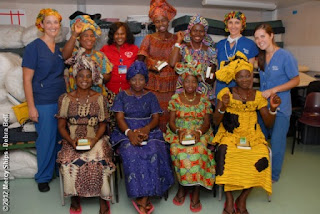
At the end of their time with us, we have a special dress ceremony for them.  It represents their new life, healed & ready to continue with their lives after many, many years of being outcasts.  They are given a new dress, jewelry, & their nails & make up done.  We gather on the ward, singing, dancing, laughing & crying, we go through all the emotions.  These beautiful women stand up & give their testimonies, their stuggles, their hope & their thanks.  We give gifts of soap (to remind them that they are washed new in Christ’s blood), a mirror (to show their beauty), a cross necklace & a Bible.  The ladies are able to leave & start their new life. 

The women on the ward are so unbelievably strong.

Blessings

Saturday, April 21, 2012

Dodji


Too cool for the ward
Working in the operating room, we don’t get to interact much with patients while they are awake.  We often meet them moments before they go to sleep & for kids, the OR is a very scary place.

One of the best features of our hospital on the ship is that the wards are just across the hall.  Its very easy to walk out of the OR & look down the hall & see all our patients in the hall.  I find myself, when I’ve had a hard day or just need a little pick me up, on the wards playing, laughing, talking with the patients.  To them I’m Amivi (my African name- pronounced “Ah-me-ve”- which means "born on Saturday") I feel blessed that I have the opportunity to interact with my patients on this level.  Back home, I only see the patients when they are having surgery, I don’t always hear or see them once they leave the operating room.  Here I can sing, dance, laugh & watch them heal right before my eyes.
Komla's leg before surgery

Due to the complexity of some surgeries & the length of recovery, some patients have been here longer than others.  One of my buddies is a little 8 year old boy name Komla.  A couple years ago, his leg got burned & the contractures prevented him from straightening his leg.  He either walked on his knees or used a long stick as he hopped on one foot, his right leg permanently tucked under him.  When he first arrived, he was terrified of everything.  He hid away, cried & screamed whenever someone came too close to his newly released leg. 

It all started with a balloon that I tossed in his direction, he reached up & hit back towards me, which I promptly hit back to him.  Soon we had a game of balloon volleyball going & he smiled for the first time.  After that it was love J  Whenever he saw me in the hall, he would scramble as fast as he could over to me & wrap his little arms around me.  Komla soon became a ward favorite. 

Dodji & Amivi
Over the months, as his leg healed, the dressing changes became less traumatic, the crutches slowly disappeared & before we knew it, he was running & playing football in the hall.  One day I called his name & he promptly told me his name was not Komla, but Dodji (pronounced doe-gee) which means “brave one”.  He sure is a brave little guy.
Dodji plays football in the hall


Blessings

Saturday, March 31, 2012

Nous Fixerons Votre Hernie!

Mercy Ships brings hope & healing to those that often get overlooked & out casted.  We provide life changing surgeries to the people of West Africa at no cost to them.  Some of the big things we do have drastic outcomes- facial tumors removed, cleft lips repaired, limbs straightened, eyes made to see again.  These are the "glamorous" surgeries.  And then you have the hernias, the not so glamorous, exciting & less "photogenic" surgeries. 

I spend most of my days in the general surgery rooms fixing inguinal hernias, a very common, very dangerous condition here in West Africa.  Because of the West African work ethic of carrying very heavy items on their heads, starting at a very early age, they often end up with hernias.  This condition impacts their lives greatly.  The pain keeps them from working as hard as they used to, or even from working at all.  The hernias go left untreated for years, getting bigger & bigger, until its noticeable outside their clothes.  The patients, usually men, can't provide for their families, often turn to drinking because they have nothing else to do.  If left untreated, they could have serious complications that could make them very sick &/or kill them.
Dr James & Dr Nabil hard at work
On the ward with the General Surgery Team-
Dr Nabil, Jen, Raphel, Germain & Annika


We had one gentleman come from a neighboring country for his hernia repair.  He had had his hernia for about 5 years & it was quite large.  The day he was being admitted for surgery, he suddenly felt sharp pain in his hernia.  He collapsed & was rushed on board.  He was quickly diagnosed with an incarcerated hernia (the bowel gets trapped & twisted, cutting off blood supply to that portion of bowel).  He had surgery almost immediately.  An hour later he would have had, at the very least, a bowel resection (removing the sick portion of bowel).  If he had been at home or any place other than our dock, he probably would have gotten very sick & possibly died.  We were able to save his bowel & he made a good recovery.  He left 4 days later praising God & saying that Jesus saved his life. 

The general room can be very busy.  We can fix 3-5 hernias a day, some are small & take about 45 minutes (these are usually kids)  & some are the size of footballs & can take 3 hours to repair.  Even though these cases sound routine & mundane, by fixing one hernia, we allow one man to go back to work, thus helping not just one person but numerous people because now he can provide for his family.
Blessings

Tuesday, March 6, 2012

Akpe Dada

February just flew by. Our first month of surgery has passed, we are starting week 5! Only 12 more weeks to go before our time here in Togo is finished. My job as OR general/VVF team leader has gotten more exciting & busy about two weeks ago when we got our first general surgeon.  We are quickly becoming the inguinal hernia repair team!  On average we will do about 20 general surgery cases a week, 19 of those will be hernias.  It’s not a very thrilling surgery, but it’s a much needed surgery here.  Without the surgery these men won’t be able to work, thus not being able to provide for their families & if left untreated, they could develop complications that could kill them.
Dinner on the dock with our Day Workers

Last Thursday we had our weekly community meeting out on the dock & invited our day workers (the local people that help us take care of the patients, cook, clean, do maintenance work around the ship & teach us about their culture) to join us for dinner & worship.  It was so much fun!  We grilled hotdogs on the dock & soon after everyone was up dancing & praising God in English, French & Ewe (one of the local languages).  We danced until well after dark, listened to a message & then danced some more.  One of my new favorite songs, that I can’t get out of my head, goes like this:

The music starts & everyone is one their feet
"Akpe Dada ye dze ne
Yesu de mi tso kume
Eye nami agbemavo
Y ate Akpe dada a edze ne"

"Akpe Dada" (pronounced: Awk Pay Dada) is Ewe for "Thank you Father"

Last weekend was a ship’s holiday for us, meaning we got a 3 day weekend!  Time to get away & explore Togo.  A small group of us went north about 2 hours to a nice town called Kpalime (pronounced: Pal lo may), known for its waterfalls & mountains.  We stayed at a YWAM (Youth With A Mission- Mercy Ships used to be part of YWAM when it first started) base outside of Kpalime, up a steep road on the side of a mountain, away from the hustle & bustle of city life.  The only sound we heard up there was birds, crickets & the wind blowing up the mountainside.  A very relaxing time.  The base was situated halfway up the mountain.  The rooms were sparse, but very comfortable with 2 sets of bunk beds, windows with screens & even electricity!  The food was wonderfully simple & filling. 
The YWAM base


The group @ the base of the waterfall
Saturday, we went into Kpalime via Zimmy Johns (motorcycle taxis) & found someone to take us to one of the many waterfalls around the town.  A short drive up a bumpy dirt road, we came to a small cement building with a small stream running next to it.  The building was a water treatment plant that the village used to treat the water before piping into their village.  A very simple, but effective system, using settling tanks & chlorine to purify the water.  We followed the trail upstream through the dense jungle until we came to a beautiful waterfall.  We couldn’t get in because it was the village’s water source, but being near the water’s spray cooled us off nicely.  We ended our time in Kpalime stopping at a local restaurant for coca colas & fanice (frozen yogurt-type treats).
The waterfall


Hiking up the mountain
Sunday, we decided to explore the mountain above the YWAM base.  We asked for directions to the trails to the top & set out a little after 8am- before the 90+ heat set in.  It was a pleasant uphill hike through the jungle; occasionally through the trees we could see the valley below.  We climbed higher & higher until the trail came out behind a local church building in a small mountain village.  As we emerged from the trees, the choir in their cap & gowns (think graduation) were singing & dancing into the church, a small one room building made of wood boards & a tin roof.  We stood outside watching & listening, because we weren’t dressed appropriately to go to church, but soon we were invited in by the congregation.  The small building was crowded with the alter- dressed in bright pink alter cloths, a 6 piece brass band playing on one side & the choir in their cap & gowns on the other side.  The choir would sing one song, the band would play another song with the congregation singing along (songs that we recognized like “Onward Christian Soldiers” & “Thine is the Glory”)  Every once in awhile, another choir would stand up in the middle of the congregation & sing some songs before sitting down again.  The service was all in Ewe & French, I had no idea what the sermon was about, but it was fun to just listen & watch the pastor get so animated with his talk. 
With Christian, our village guide

After the service, a gentleman came up & offered to give us a tour of the village.  The village of about 2,000 people was situated on the side of the mountain, just shy of the top.  From the town square, we could see for miles, even in to Ghana, & the view was amazing!  The village was none like we have ever seen.  The houses were in good condition, the streets clean & there was electricity & running water.  A large school building was next to a new church building being built, with a large soccer field that had the same amazing views that the rest of the village enjoyed.  The people were very friendly & we were invited back anytime to visit.  Heading back down the trail, we all decided that if we could all live there & be quite happy.
The mountain village

 Blessings

Saturday, February 11, 2012

Week 1


Team Awesome in OR 3
I'm back to being an OR nurse.  I'm so excited to be back in an environment that I feel I belong.  Our first patients came into the OR around 0830 Monday morning, a little baby with a cleft lip & a little girl needing a CT scan under anesthesia for an encephalocele.  

Our staff is from all over, USA, UK, Germany, Australia, New Zealand, Malaysia, & Holland.  Soon we were falling into a routine, one that we all were familiar with- no matter what country we were from. 
Number 2- Jen

Number 5- Tina
We had some long days, & some big cases- all turned out well.  We had 3 maxfax (facial) surgeons this week, we did some cleft lips & palates, removing some jaw tumors & other large facial tumors.  With one week down, we only have 16 more weeks to go.

We are still in desperate need for some general surgeons to come & work with us.  Please pray that our needs will be met.

Blessings

Friday, February 3, 2012

Screening Day

Part of getting ready to become a hospital ship again, is to find patients we can help with surgeries. This is a time consuming & often heartbreaking job, with thousands of people turning up with the hope that they might be one of the lucky few that get chosen.

The line outside the stadium
The screening process this year took place at the local football (soccer) stadium here in Lomé. The night before the screening, lines started to form outside the stadium. We had the military on hand for security & some brave souls out there all night to tell the people what conditions we can help with. When the first of us arrived Wednesday morning at 0515, there are just shy of 1000 people outside the gates.

Pre Screening Patients
My role during the screening process was that of a pre-screener. It was my job, armed with a clipboard, tickets & a translator, to do a quick interview with each patient that came into the stadium & determine if they had something we could fix. They entered through the gate & got into 4 lines, where a pre-screener would look at them & say “yes” or “no”. If they were a “yes”, they were given a ticket & able to move on. If they were a “no”, they were escorted to the prayer station, where we would pray over them & then they would leave. This by far was the hardest. During our pre-screening briefings, we were told that people in Africa are used to hearing “no”. They hear it quite often, but they will still come with the chance that this time they might hear “yes”.

We had certain criteria that had to be met, depending on what they were presenting with. We only do certain types of surgeries & it was our job, as pre-screeners, to “weed” out those that we might be able to help with those that we can’t help. We not only looked at what they had, but how old they were, how big the issue was- meaning was it something that was impeding their movement or left them horribly disfigured.

I had a mother bring her tiny baby up to me, I didn’t even ask her what we could help her with, I just took one look at that baby & realized that this baby was dying right before my eyes. This 6 month old looked like a skeleton, he was so emaciated & frail. I turned to my supervisor & we quickly took the baby to the nutritional tent. Not sure if he’ll make it.

My beautiful Yellow Angel
I had a little 2 year girl in a beautiful yellow dress come with her mother. She was perfect, beautiful & with the biggest smile. She wasn’t afraid of the strange Yovo (white person) standing in front of her. Under her dress, I could see that her legs weren’t right, they were bowed, giving her a weird waddle when she walked. Normally, this would be something we could fix, but since we are only in Togo for a short 5 months, we are not doing any ortho, because we won’t be here long enough for physical therapy. My heart broke when I had to send her & her older sister (with the same issue) away. It’s not fair.

As the morning wore on, I saw so many people that if we were somewhere else, wouldn’t have to stand in long, long lines waiting to be seen in the chance they might get the surgery they so desperately needed. If they had been born in the States or in Europe, they would have gotten the care they needed. Thank God for my translator, Frank. He made things so much easier for me. Since I don’t speak French or Ewe (one of the local dialects), he learned what I would say & then say it without me having to say it first. I felt bad that he was the voice that said “no”, but I got to the point where I didn’t want to anymore.

Pre-screening went from 0545 to 1245. Of the 3,000 people outside the gate, 1,600 made it into the pre-screening lines. Of those, about 1/3 made it past that. Those that got a “yes” went on to be registered & have their history taken. They were divided up into specialty groups- max-fax (ie: cleft lips, facial tumors, etc), general (hernias, etc), plastics (burns, keloids), VVF (female fistulas) & goiters. They would then be seen by the different surgeons & doctors. If it was determined that yes, we can help them, they would continue on to get scheduled for surgery.

When I was done with pre-screening, I went to help with surgery scheduling. It was a nice change to be on the other end of the process. I didn’t have to say no to anyone who came to me. I would see when we had an opening & give them their appointment card, telling them what day their surgery was. These people had beat the odds & made it to the end & now knew they would be changed forever.

At the end of a long, but successful day
The day ended around 1900 (7pm), a very long, but successful day. We got a lot of people scheduled for the next 5 months; others will come back for a smaller screening with the individual surgeons when they arrive. The screening process went smoothly, no issues with crowd control or safety. Even though it was hard to turn people who we can't help away, we are still able to help so many people that it makes the day worth it.

We are EXTREMELY short on general surgeons. We had some surgeons back out at the last minute. So if you or if you know someone who would like to come & play with us here in Togo, let me know ASAP! It was hard enough to send people away at screening we don’t want to send the people we promised to help away just because we
don’t have a surgeon. Thank you


Blessings