Saturday, June 16, 2012

Cast Off Your Mooring Lines & Set Sail

 The time has come, we are leaving Togo.  To be honest, when I first heard we were coming to Togo I was a bit skeptical.  Mercy Ships was just there in 2010, why are we going back so soon?  Do they really need us?  I don’t speak French, how am I supposed to connect with my patients?  I really didn’t want to go.  Funny how looking back over the last 5+ months, I realized there was no other place I would have wanted to go. 
Goodbye Togo!

Mercy Ships had done a short field service in Togo in 2010, only 5 months while most field services are 10 months.  We were just returning to finish what we started then.  We were able to provide over 1,500 surgeries to people who would probably never receive care.  We taught 7 local surgeons new surgical techniques, allowing them to provide care to the people.  We provided over 10,000 dental procedures & helped thousands more with our off-ship programs.  Random fact: Togo was the first country in Africa Mercy Ships ever visited back in the early 90’s.
Captain John gives the go ahead

Casting off our mooring lines
I’ve learned through my travels that speaking the local language is important, but not necessarily a deal breaker.  Nursing has its own language that is universal; a kind touch, a smile, a soothing voice is often all that is needed to convey to your patients that you are there to help them.  Plus, I always had our awesome dayworkers there to help with the more complicated things like asking questions & giving instructions.  Kids are also the best teachers when it comes to learning a new language.  They are patient & love to show you new things.  I often go straight to the kids when I meet a new group of people, they accept me & I’ve learned that people begin to develop trust in you when they see how you interact with their children.

Saying goodbye
Leaving Togo behind
Now our time has come to leave.  A small crowd of mainly dockworkers, crew members that were staying behind & the government officials gathered on the dock to see us off.  The last crew member was on board by 0930 & our mooring lines were let go around 1000.  Slowly, we slipped out of the harbor & into open waters, heading west towards Tenerife.


Goodbye Togo, I’ll miss you!

Blessings

Thursday, June 14, 2012

Tying Up Loose Ends

The hospital is closed, the ship getting ready to leave Togo, & we have a list of things to do before we leave:

First: Day Worker Thank You

Our awesome dayworkers
The OR team
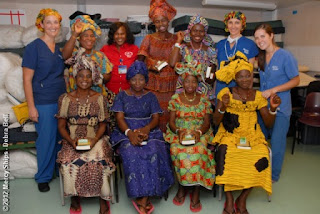
We held a special celebration in honor of all of our dayworkers (the local people who translated, cleaned, cooked, did maintenance work & taught us about the Togolese culture).  In the OR, PACU & sterilizing, we had 7 wonderful translators, Marie, Thomas, George, John, Gratias, Mark & Holali.  Over the months they provided a bridge between us & our patients, stepping in to hold a hand or explain a procedure.  Not only did they help us in the OR, but they invited us to their homes, helped us navigate the markets & the streets of Lomé.  Our day workers became more than just colleagues, they became friends.

Second: Find local music cds

With Gratias & her family
Ginger at the music store
Heading back to the ship
Jen on a "zimmyjohn"
On the wards, we learned some fun local worship songs.  We loved dancing to them & we wanted to find those songs so we could always remember Togo.  We asked on of our dayworkers, Gratias, if she’d help us.  She agreed & sent her brother to come pick us up.  Now, the main form of transportation in Togo is by motorcycle & motorcycle taxis called “zimmyjohns”.  Her brother helped us acquire a couple “zimmyjohns” & away we went!  He took us to a small music store that was more of a shack.  We spent a lot of the afternoon trying to remember all the songs we loved so much, & drew a small crowd as we sang or hummed what we could remember.  Most of the songs were either in Ewe or French & we didn’t know the names of the songs, or even the words for that matter. I’m pretty sure they thought we were crazy “Yovos” (Ewe for white person).  Once we found the songs we were looking for, we walked to Gratias’ house to meet her mother & family before we said our goodbyes & took “zimmyjohns” back to the ship.


Third: Look for contraband

Checking a ceiling access
In one of the crawl spaces
Checking one of the lifeboats
With the hospital closed, the nurses are reallocated to different departments to help fill the gaps as people leave.  I have been reassigned to security, meaning that I help keep the ship safe while in port & watch for pirates while at sea.  Part of the job required us to search the entire ship for things that don’t belong & stowaways.  We divided up into teams & divided up the ship to begin our search.  We had to look everywhere- behind walls, in the ceiling, we crawled into small spaces & up ladders, we even checked the lifeboats & the ship’s funnel.  It took the whole day & we learned there was more to the ship than just what we saw everyday! 

 
Finally: Relax

Out to eat with friends
Togo offers a lot of fun things to do & wide selection of restaurants.  We spent our last day in Togo relaxing poolside at the Seamen’s Mission- a Christian restaurant/hotel established to cater to the ships in the port by providing clean & affordable services to the men on the ships.  It’s within walking distance of the port & they even offer a free shuttle service to & from your ship in the evenings.  Behind the Seamen’s is the German Restaurant that serves very yummy food.  Eating good food & relaxing by the pool was a great way to spend our last day.

Tomorrow we leave Togo; it’s a 10 day sail to Tenerife in the Grand Canaries.  I guess it’s time to start a new adventure.

Blessings

Saturday, June 9, 2012

C'est Fini

It seems like yesterday we were untying equipment, making beds, bleaching walls- turning a normal looking ship into a hospital.  The past 5 months have flown by.  As our last week of surgery came & went, it brought a sense of accomplishment of a job well done, as well as a feeling of sadness that we were done.
We are the Pirates of the OR- Arrgh!
Gratias sporting a very piratey eye patch
In the OR, we celebrate the last week of surgery & a job well done with a party & a little OR humor.  One day the OR was over runned by pirates, who happened to look like doctors & nurses.  No one walked the plank & there was no buried treasure, but I think there was a parrot, it was a great excuse to have a bit of fun & sword fights... :)

One last hug
Saying goodbye to Komla
Saying goodbye to Hougno
Hougno waves as he leaves
The hardest thing about the end of an outreach is saying goodbye to the people we’ve meet & cared for during our time here.  I had made some special bonds with a couple of boys who had been on the wards for months while they healed from their surgeries.  I often spent the evening with my buddies walking up & down the hall exercising, or just sitting & playing games or watching a movie.  We didn’t speak the same language, but that didn’t matter.  They had been with us so long it was hard to imagine the wards without their smiley faces.  When it came time for them to go home, it was heartbreaking.  I helped walk them out & plastered a big smile on my face as I helped them get into the landrovers, & waved as they drove away.  I hate goodbyes.
The ORs are packed

Packing is always an inevitable part of end of outreach preparations.  It requires a lot of time, creativity & elbow grease.  It took about 2 weeks to get the ORs ready for the high seas.  The rest of the ship was right behind us with their preparations.  Tents on the dock came down, containers packed, landrovers were lifted up onto the deck & secured.  Doctors, nurses, crew members who had been with us since we arrived have left in large groups.  The ship feels empty.


The halls are quiet, the beds are empty, the last patients have gone.  The hospital is officially closed.  All good things must come to an end & so must our time here in Togo.  The ship is ready to leave, but I wonder if I am.

Blessings

Saturday, June 2, 2012

Impromptu Dance Party

One of my favorite things about being in Africa is the music.  I love to hear the African drums & the shakers & the songs.  They are so different from the music we listen to at home, so beautiful & down to earth.  I’ve learned that drums have an important place in African society, children learn at a young age how to play.  Its more than just slapping the drum with your hand, there’s an art to it.  When the drums start to play, whether its outside on the dock, in the International Lounge, the wards or in a village, it gathers people together, it lifts spirits & makes people feel happy & a part of the community.  Also, its impossible to just sit & listen; drums will have you on your feet, dancing along with the crowd.

One Saturday night not to long ago, we decided to celebrate birthdays out on the dock.  It had just stopped raining & we gathered under one of the tents for a BBQ.  Soon, someone brought the drums out & started playing.  We danced out on the dock, avoiding the giant rain puddles, just laughing, singing & dancing with our friends.  The patients from the wards joined us & a dance party had begun.  I love these impromptu dance parties.


Blessings

Sunday, May 6, 2012

From Suffering to Beauty

When I told people I was the OR VVF team leader, I would get blank stares.  “What is VVF?” they would ask.  I would respond with a vague “it’s a fistula caused by childbirth” because, really, I had no idea either.  That was until I found myself standing in the ward surrounded by women who had these fistulas. 

Here’s what I learned over the past month about VVF:

1-     VVF stands for vesico-vaginal fistula which is a hole between the bladder & vagina & is only one type of fistula, there’s also vesico-uterine (a hole between the bladder & uterus), urethro-vaginal fistula (a hole between the urethra & vagina) & recto-vaginal fistula (a hole between the rectum & vagina).  The fistulas cause them to be incontinent of urine & feces.

2-     It’s a symptom of poverty caused by lack of education & availability of healthcare

3-     VVFs are caused by obstructed labor, the women can spend days in labor, often times going to 2 or 3 hospitals or clinics before they find one that would accept them either because they can’t pay or the clinic has no operating room for a c-section.  When they are able to deliver, the baby is dead & the mother is left in ruin.  Fistulas are totally preventable by having access to healthcare & have been eradicated in the Developed world because of the availability of c-sections.

4-     Other complications of obstructed labor include: foot drop, nerve injury, infertility, skin breakdown, kidney disease, prolaspe & maternal death.

5-     The social ramifications are astounding, the women are often out casted because they are wet & smell.  Their husbands leave them because they can’t produce live children any more.

6-     Its not always the young girls (under 17) having babies at a higher risk, most fistulas happen to women of normal child-bearing age.  Its also not always the first baby that causes the problems, the 5th, 6th, etc can be the culprit. 

Working with these women & hearing their stories of pain & suffering & yet seeing their smiles, tears, & laughter has shown me a new understanding to the human spirit.  I love coming down to the ward & sitting with the women when they are on bed rest after their surgery, or joining the “VVF conga line” in the hallway, as the ladies go on their daily walks, singing & dancing as they go.


At the end of their time with us, we have a special dress ceremony for them.  It represents their new life, healed & ready to continue with their lives after many, many years of being outcasts.  They are given a new dress, jewelry, & their nails & make up done.  We gather on the ward, singing, dancing, laughing & crying, we go through all the emotions.  These beautiful women stand up & give their testimonies, their stuggles, their hope & their thanks.  We give gifts of soap (to remind them that they are washed new in Christ’s blood), a mirror (to show their beauty), a cross necklace & a Bible.  The ladies are able to leave & start their new life. 

The women on the ward are so unbelievably strong.

Blessings

Saturday, April 21, 2012

Dodji


Too cool for the ward
Working in the operating room, we don’t get to interact much with patients while they are awake.  We often meet them moments before they go to sleep & for kids, the OR is a very scary place.

One of the best features of our hospital on the ship is that the wards are just across the hall.  Its very easy to walk out of the OR & look down the hall & see all our patients in the hall.  I find myself, when I’ve had a hard day or just need a little pick me up, on the wards playing, laughing, talking with the patients.  To them I’m Amivi (my African name- pronounced “Ah-me-ve”- which means "born on Saturday") I feel blessed that I have the opportunity to interact with my patients on this level.  Back home, I only see the patients when they are having surgery, I don’t always hear or see them once they leave the operating room.  Here I can sing, dance, laugh & watch them heal right before my eyes.
Komla's leg before surgery

Due to the complexity of some surgeries & the length of recovery, some patients have been here longer than others.  One of my buddies is a little 8 year old boy name Komla.  A couple years ago, his leg got burned & the contractures prevented him from straightening his leg.  He either walked on his knees or used a long stick as he hopped on one foot, his right leg permanently tucked under him.  When he first arrived, he was terrified of everything.  He hid away, cried & screamed whenever someone came too close to his newly released leg. 

It all started with a balloon that I tossed in his direction, he reached up & hit back towards me, which I promptly hit back to him.  Soon we had a game of balloon volleyball going & he smiled for the first time.  After that it was love J  Whenever he saw me in the hall, he would scramble as fast as he could over to me & wrap his little arms around me.  Komla soon became a ward favorite. 

Dodji & Amivi
Over the months, as his leg healed, the dressing changes became less traumatic, the crutches slowly disappeared & before we knew it, he was running & playing football in the hall.  One day I called his name & he promptly told me his name was not Komla, but Dodji (pronounced doe-gee) which means “brave one”.  He sure is a brave little guy.
Dodji plays football in the hall


Blessings

Saturday, March 31, 2012

Nous Fixerons Votre Hernie!

Mercy Ships brings hope & healing to those that often get overlooked & out casted.  We provide life changing surgeries to the people of West Africa at no cost to them.  Some of the big things we do have drastic outcomes- facial tumors removed, cleft lips repaired, limbs straightened, eyes made to see again.  These are the "glamorous" surgeries.  And then you have the hernias, the not so glamorous, exciting & less "photogenic" surgeries. 

I spend most of my days in the general surgery rooms fixing inguinal hernias, a very common, very dangerous condition here in West Africa.  Because of the West African work ethic of carrying very heavy items on their heads, starting at a very early age, they often end up with hernias.  This condition impacts their lives greatly.  The pain keeps them from working as hard as they used to, or even from working at all.  The hernias go left untreated for years, getting bigger & bigger, until its noticeable outside their clothes.  The patients, usually men, can't provide for their families, often turn to drinking because they have nothing else to do.  If left untreated, they could have serious complications that could make them very sick &/or kill them.
Dr James & Dr Nabil hard at work
On the ward with the General Surgery Team-
Dr Nabil, Jen, Raphel, Germain & Annika


We had one gentleman come from a neighboring country for his hernia repair.  He had had his hernia for about 5 years & it was quite large.  The day he was being admitted for surgery, he suddenly felt sharp pain in his hernia.  He collapsed & was rushed on board.  He was quickly diagnosed with an incarcerated hernia (the bowel gets trapped & twisted, cutting off blood supply to that portion of bowel).  He had surgery almost immediately.  An hour later he would have had, at the very least, a bowel resection (removing the sick portion of bowel).  If he had been at home or any place other than our dock, he probably would have gotten very sick & possibly died.  We were able to save his bowel & he made a good recovery.  He left 4 days later praising God & saying that Jesus saved his life. 

The general room can be very busy.  We can fix 3-5 hernias a day, some are small & take about 45 minutes (these are usually kids)  & some are the size of footballs & can take 3 hours to repair.  Even though these cases sound routine & mundane, by fixing one hernia, we allow one man to go back to work, thus helping not just one person but numerous people because now he can provide for his family.
Blessings